01
/portfolio
Living Systematic Review
Mayo Clinic /2025
Product Design
LLM Integration
UX Strategy
Healthcare UX

Human - Ai collaborative interface
The Challenge
Living Systematic Reviews are designed to keep medical evidence continuously up to date, yet the workflows that support them remain slow, fragmented, and cognitively demanding. Reviewers must manually extract and verify data across thousands of PDFs using disconnected tools, leading to fatigue, delays, and increased risk of error. While AI has the potential to accelerate this process, existing solutions lack the transparency and traceability required for clinical trust. These challenges are not merely operational inefficiencies, they directly impact how quickly validated evidence reaches clinical practice.
Why this matters?: In healthcare and research settings, speed without trust is unusable. If reviewers cannot clearly verify where data comes from or how it was generated, AI-assisted workflows fail to gain adoption, regardless of efficiency gains.
What I Set Out To Learn
Rather than jumping to interface solutions, we framed our work around three key questions:
"Where does cognitive load peak during the extraction workflow?"
"What prevents reviewers from trusting AI-assisted tools?"
"How can Human–AI collaboration remain flexible without disrupting existing mental models?"
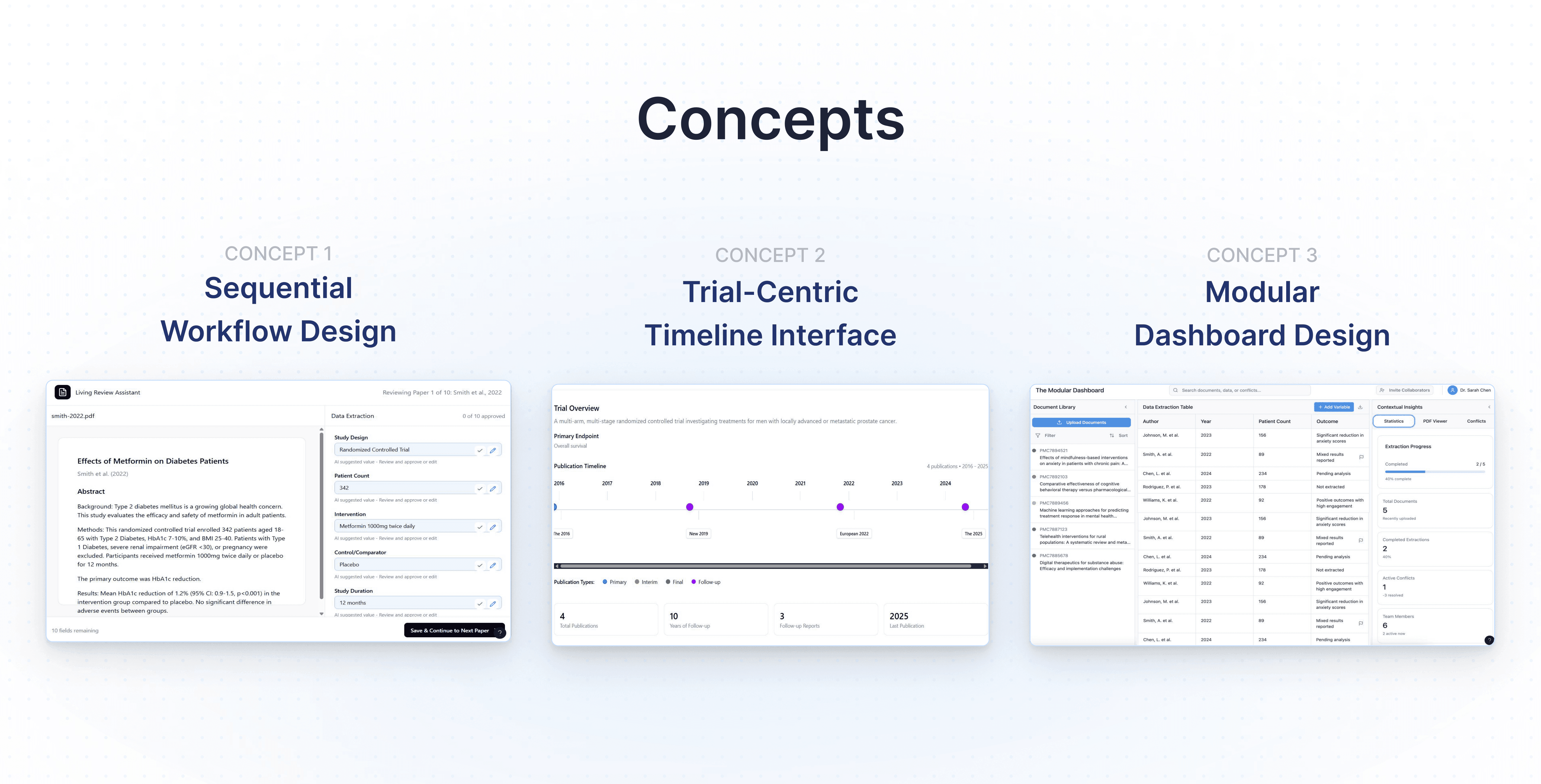
Research & Concept Exploration
Methods used were co-designed with SMEs, domain constraints, and trust requirements.

Design Strategy
Living Systematic Reviews are designed to keep medical evidence continuously up to date, yet the workflows that support them remain slow, fragmented, and cognitively demanding.


Impact Summary
Living Systematic Reviews are designed to keep medical evidence continuously up to date, yet the workflows that support them remain slow, fragmented, and cognitively demanding.


Future Steps
delays, and increased risk of error. While AI has the potential to accelerate this process, existing solutions lack the transpare

Learnings
This project taught me how to design for trust in high-stakes environments, approach AI as a UX challenge rather than a technical one, and think in systems instead of screens. Collaborating with domain experts and working within real-world constraints strengthened my ability to design thoughtful, scalable workflows that balance efficiency with accountability.
02
/see more